|
What
is chromatography?
In chromatography,
the separation process
involves the interaction of
solutes and two phases:
The STATIONARY
PHASE - a solid or
liquid immobilized
either in a column or on a
planar surface.
The MOBILE PHASE- A gas or liquid
that carries the analyte and
moves through the stationary
phase.
Individual components
of a mixture are retarded by
the stationary phase at
different rate based on
differences in surface
adsorption, relative
solubility, charges, etc.
Chromatographic
methods can broadly be divided
into two: Column and planar
chromatography. In column
chromatography, the stationary
phase is packed in a narrow
tube and the mobile phase
forced through the column
under pressure or gravity. In
a 'planar chromatography', the
stationary phase is supported
on a flat plate or in the
pores of a paper and the
mobile phase moves either
through capillary action or
under gravity.
One common
chromatographic terminology is
elution which involves
washing a solute through a
column by addition of fresh
solvent.
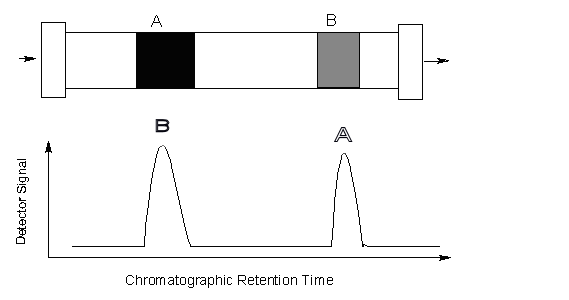
Fig. 1.2. Separation of
Compounds Using Column
Chromatography
By using an
appropriate detector that
responds to solute
concentration, a signal for
components of a mixture can be
obtained as a function of
time. This plot is called a chromatogram
and used both for quantitative
and qualitative analysis.
Next
Back
to Chromatographic methods'
page
We offer
teaching/training,
collaborative research and a
range of consultancy Services
in this field.
Pharmacognosy
Research and Herbal Analysis
Services UK Ltd
A
company registered in
England and Wales - Company
Number: 16773437
Registered
office: 124 City Road, London,
EC1V 2NX, United Kingdom
Home
.................We value
your feedback..................
FOLLOW US ALSO ON THE
FOLLOWING:


|