|
Chromatographic
theories
Chromatography is
based on differential
partitioning of solutes
between the mobile and
stationary phase. For the
solute species A, the
equilibrium is described by
the equation:


Retention
time = tR
= Time required for the peak
to reach to the recorder i.e.
time between injection of the
sample and appearance of a
solute peak at the detector.
In
the above example (Fig.
1.2) which compound is
retained more by the
stationary phase?
The time
required for the solvent alone
to pass through the column is
called dead time (tM)
How
do we measure dead time?
The
average linear rate of solute
migration, ῡ, is
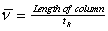
and
Average velocity,
u of mobile phase
is, u
= 
hence
ῡ = u x
fraction of time solute spends
in mobile phase
ῡ = u x
moles of solute in mobile
phase/total moles of solute
if
CM = molar
concentration of solute in
mobile phase
VM = volume
of mobile phase for CM
CS = solute
concentration in stationary
phase
VS = Volume
of mobile phase for CS
ῡ = u x CM
VM/ CM
VM + CS
VS
The volume of
mobile
phase required to carry the
component solute molecules
through the column and then to
the detector is often called retention
volume (VR)
and can be calculated as:
VR
= tR FM
Where
FM the
flow rate
FM = (pd 2/4)
x e where d
is internal diameter of the
column and e is total
porosity of the column.
Further
useful chromatographic
parameters are capacity
factor (k’) and selectivity
factor (a).
k’ = K
VS/ VM
= (tR –tM)/tM
Using
Fig. 1.2 as an example,
the selectivity factor of a
column for compound A and B
is:
a = KB/KA
=
k’B/ k’A
Next
Back
to Chromatographic methods'
page
We offer
teaching/training,
collaborative research and a
range of consultancy Services
in this field.
Pharmacognosy
Research and Herbal Analysis
Services UK Ltd
A
company registered in
England and Wales - Company
Number: 16773437
Registered
office: 124 City Road, London,
EC1V 2NX, United Kingdom
Home
.................We value
your feedback..................
FOLLOW US ALSO ON THE
FOLLOWING:


|